Smart inventory planning built on state-of-the-art forecasts
Fewer stockouts.
Less stock. Both at once.
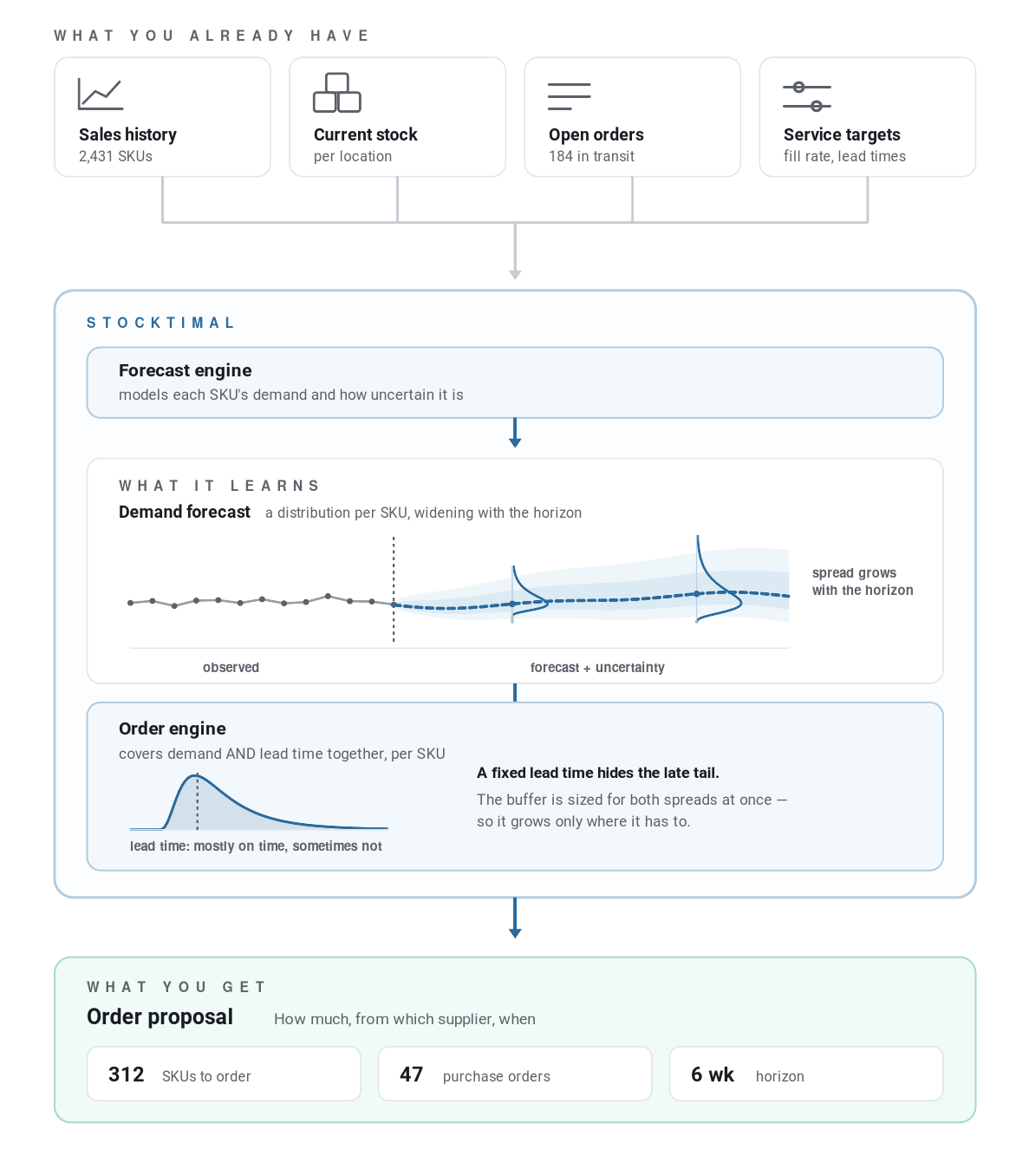
Most stock is not held for the demand you expect, but for the uncertainty around it. Stocktimal forecasts, per SKU, how big that uncertainty really is and works out the buffer you need. Not from rules of thumb, but from the actual demand pattern. So stock can come down on the predictable lines, while the erratic ones get more buffer. The result is a concrete order proposal: what to order, how much, when and from which supplier.
The problem
Ordering means committing before you know the demand.
Order too little and it costs you revenue. Order too much and it ties up working capital, and can end in write-offs. The margin is made precisely in between. Yet plenty of companies still run their stock on a handful of simple rules of thumb.
The stockout the rep phones about
A fast mover has run out. The customer does not wait, but buys elsewhere. That costs more than the one sale: the competitor may turn out to suit them fine.
The spreadsheet one person understands
With a safety stock that was set in 2019. Nobody remembers why any more, or whether it still makes sense today.
Seasonal patterns nobody has time for
Demand moves with seasons, promotions and trends. Keeping track of that by hand across thousands of lines simply cannot be done.
Where the difference is
Most tools forecast a single number. We also work out how uncertain that number is.
Demand is lumpy. Three weeks of nothing, then suddenly a pallet. A single forecast number does not show that uncertainty. So the safety stock often ends up a rule of thumb: too much buffer on the predictable lines, too little on the erratic ones.
For each SKU, Stocktimal models not only the expected demand but also the possible deviations around it. That way every line gets a buffer that matches the uncertainty measured for it.
Process
How it works
Stocktimal is set up around your current catalogue and commercial targets. The models are calibrated on your own demand data. After that, current demand, stock and open orders are read in periodically — weekly, for example. Stocktimal forecasts demand, works out the stock you need and determines, per SKU, what to order and when. Scenarios are straightforward to run too. What happens with 10% more demand? Or if a supplier delivers two weeks later? The adjusted situation can be set alongside the original plan, so you see straight away what changes and why.

Connect the data
Sales history, current stock and open orders. Through an integration or an upload, whichever suits best. Your ERP stays the source of truth, as it is now.

Stocktimal forecasts demand
First we work out, per SKU, which model best fits the historical demand. Stocktimal then uses that model for the forecasts, and the model can be updated with new data at any time. Already have a good forecast? We can use that instead.

Optimise the stock
Stocktimal weighs the forecast against service targets, lead times, costs, minimum order quantities and pack sizes. Out of that comes the order quantity and order date for each SKU and supplier.

Review, adjust, export
Every line shows how the proposal came about. Change what needs changing, approve the rest and export to CSV. Every run is kept and can be re-run later on the same inputs.
Who it's for
Who Stocktimal is built for.
Stocktimal is a good fit when
- You hold stock across hundreds to a few thousand SKUs — in wholesale, food and beverage, e-commerce, retail or manufacturing, for instance.
- A fair part of the catalogue sells irregularly, and standard ordering rules cope badly with that.
- Both service level and working capital matter, but the trade-off between them is still mostly made on experience and rules of thumb.
- The planning logic needs to be written down and repeatable, rather than depending on what one person knows.
Stocktimal is less of a fit when
- What you actually need is an ERP, a WMS or a full S&OP suite.
- Ordering has to run fully automatically, with no human review.
Why we built it
From uncertain demand to a purchase order
Stocktimal is built by RAW Analytics. For decades we have built models that turn uncertainty into concrete decisions, including for large banks and insurers in the Netherlands.
We now apply that knowledge to demand forecasting and inventory optimisation. It soon became clear that one standard approach does not work. Products differ in forecast horizon, ordering windows, lead times, shelf life and minimum order quantities. And sometimes the forecast itself calls for a different approach too.
That need is what we built Stocktimal for: flexible enough to apply the right forecast and the right optimisation per product, but within one repeatable process.
A free trial run on your own catalogue
One export is enough: sales history, current stock and open orders. We forecast your demand per SKU and show you what Stocktimal would order on that basis — next to what you actually ordered, with the differences explained. You keep the output, even if nothing comes of it. No integration, no access to your ERP and no implementation project. Just one file.